


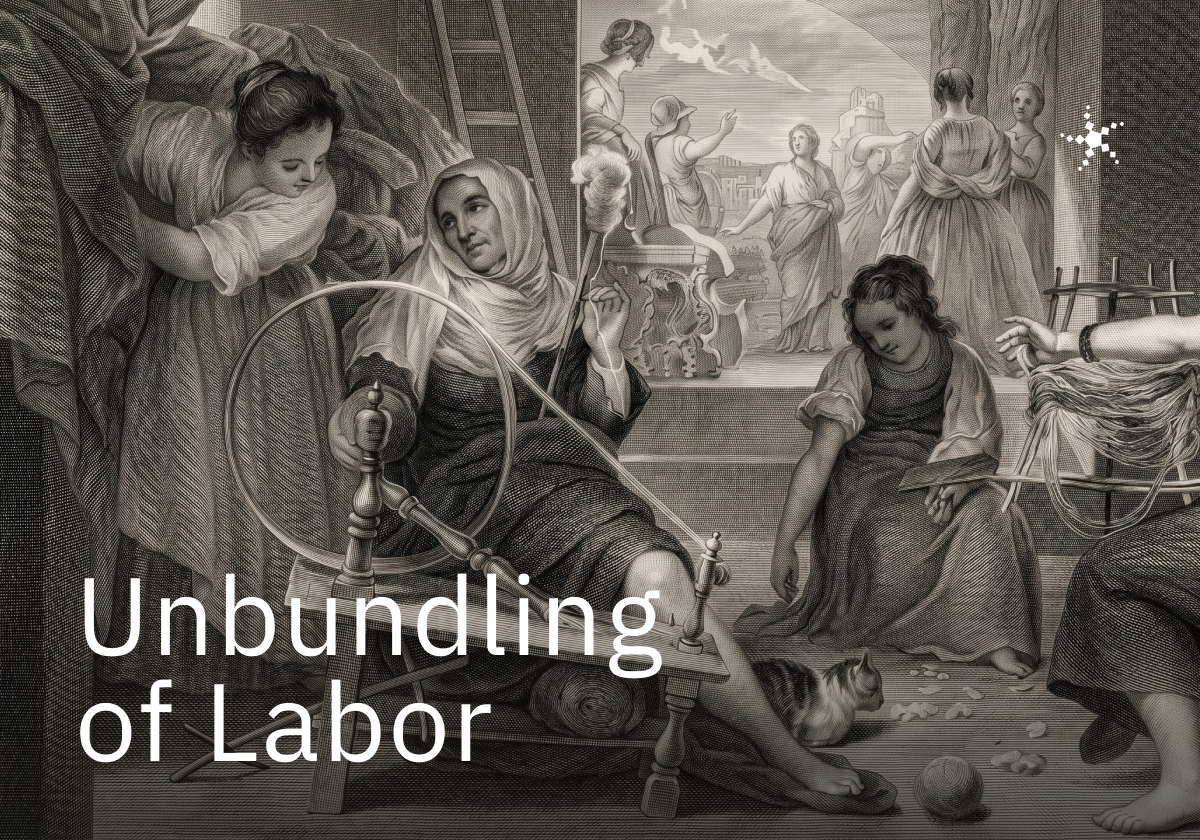
Unbundling of Labor
In 2024, Sam Altman made the provocation that a one-person billion dollar company would emerge imminently with the rise of artificial intelligence. The core shift: humans are now scalable in the one way that has always been a constraint. Time. What does the world of building look like when intelligence isn't bottlenecked by the need for humans to sleep, but scales with machines that never tire?
Imagine an agent commissioning another agent for a task and paying in USDC on receipt, settling onchain in 400ms with no intermediary validating the transaction. Or an athlete licensing their signature touchdown dance for a video game campaign recreated using a world model. Or maybe a scientist accessing a niche dataset for a single experiment and paying the researchers who collected it.
We are closer to this than most people realize. And the fear that dominates the conversation (AI is taking jobs) misses the more interesting structural question: what happens when the unit of labor itself changes?
Every Transition Bundles, Then Unbundles The Firm
Ronald Coase offered the clearest explanation for why firms exist in his 1937 essay The Nature of the Firm. Companies internalize labor when the cost of coordinating through the market exceeds the cost of hiring. Every major labor transition in history has been a direct result of reducing those coordination costs. When you lower the friction of finding, paying, and managing work, the boundary of the firm shifts, and work that once had to happen inside a company can happen outside of it.
Historical artisans operated through multi-node supply chains, each craftsperson capturing a portion of the value, with skills passed down through generations of apprenticeship. The industrial revolution collapsed that distributed model into the factory, which captured the majority of production value by centralizing coordination under one roof. The internet and mobile lowered matching and coordination costs again, giving rise to the gig economy (Uber, DoorDash) and the creator economy, where individuals with cameras and internet connections began doing work that previously required studios, publishers, and agencies.
The Bridge Class
Each of these transitions produced a bridge class that proved the new model was possible before the infrastructure existed to capture its full value. Artisans proved distributed production could work; factories captured the value by centralizing it. Creators proved individuals could build audiences and generate revenue at scale; the platforms (YouTube, Instagram, Substack) captured the economics and provided the Schelling point.
The bridge class absorbs the risk of new technology and validates the demand. Then the infrastructure catches up, and a new set of institutions captures the value at scale.
The gig economy and the creator economy were the most recent bridge classes. They showed that work could be decomposed, distributed, and compensated outside the traditional employment relationship. But they still depended on platforms to bundle the economics: Stripe to process the payment, YouTube to distribute the content, Uber to match the ride. The coordination costs dropped, but they did not disappear, because the payment and identity infrastructure still presumed a human on both sides of the transaction.
Programmable Labor Meets Programmable Money
We are now in the early phase of the next transition, and it hinges on two things arriving at the same time.
The first is programmable labor. AI agents represent a new class of labor participant unconstrained by hours, headcount, or geography, and scaling with compute rather than with hiring. A top-level agent can decompose a task, commission specialized sub-agents, evaluate their output, and route the next step, all without a human in the loop. The relevant unit of labor is no longer the role, the hour, or even the deliverable. It is the task.
Humans packaged tasks into jobs, jobs into careers, and careers into firms because that was the only organizational construct available. When you can price and route individual tasks directly, bundling becomes optional rather than structural.
The second is programmable money. Stablecoins represent a roughly $300 billion asset class today, with credible projections toward $2 trillion in the next several years. They dissolve the payment supply chain into a single programmable transaction. The gig economy could not fully unbundle labor because you still needed Stripe, PayPal, or a bank account on both ends, infrastructure that presumed an ongoing relationship between known parties.
Stablecoins could be the best solution for a new labor class: agents. An agent can pay another agent per output, in fractions of a cent, settling in under 500 milliseconds with no account creation, no invoicing, and no intermediary. Meta recently began offering USDC payouts to creators on Polygon and Solana, and AWS launched AgentCore with stablecoin-based micropayments for agent-to-agent commerce. These are early signals that the largest technology companies in the world view stablecoins as the settlement layer for the next generation of economic activity.
Together, programmable labor and programmable money make it possible for the first time in history to have a production pipeline with no organizational entity: no firm, no payroll, no HR department, just a set of tasks being routed, executed, priced, and settled at machine speed.
That is the real unbundling of labor and here's what it looks like in practice:
Merit Systems built a product called Poncho that makes this concrete. Poncho gives an AI agent a wallet. The agent can cross paywalls, access premium tools, and pay for services on its own, only paying for the exact usage they need. It connects to payment protocols like x402 and MPP, which embed payment authorization directly into HTTP requests. The agent sees a price, pays it, and receives access.
This represents a different model for how economic value moves through the internet. Instead of subscribing to a bundle of services you may or may not use, an agent can pay for exactly the data, the API call, or the compute it needs to complete a specific task.
The early internet explored this idea under the banner of microtransactions, but it never took hold because the infrastructure couldn't make credit card fees work economically, among a myriad of other challenges. There was no internet-native payment rail. Stablecoins use infrastructure like Solana or Ethereum to settle transactions instantly for fractions of a cent, which means the pricing can finally match the granularity of the work.
The Re-Bundling
If you assume that work will increasingly be done by agents paying other agents per task, the shape of a company changes. You do not need to internalize every function. You need to be excellent at defining what needs to be done, how quality is measured, and how the outputs compound into something greater than the sum of their parts.
This extends to the creator economy. Tipping has never worked well peer-to-peer; Clubhouse and Farcaster both demonstrated the limits. But microtransactions are perfectly suited for machine-to-machine interaction, where there is no social awkwardness around small amounts and no expectation of reciprocity. If agents become the primary consumers of digital content, the subscription and paywall models that have dominated the internet may give way to per-use pricing enforced programmatically. As AI-generated content saturates every channel, the premium on human judgment and craft will increase, and the most interesting business models will sit at the intersection of human taste and machine execution.
The role of the human in an agent-driven economy is to re-bundle labor. You are the orchestrator. Your job is to design systems where agents perform disparate tasks in a specific configuration that builds a flywheel toward your desired outcome. The value is in knowing what work to commission, how to evaluate it, and how to compose it into something that compounds.
The firm does not disappear, but the firm of the future looks less like a container for labor and more like an intelligence layer that sits on top of a global, programmable labor market.
The content provided herein may include information regarding past and/or present portfolio companies or investments managed by Blockchain Capital or its affiliates and are provided for illustrative purposes only. The views expressed in each blog post are the personal views of each author and do not necessarily reflect the views of Blockchain Capital and its affiliates. Neither Blockchain Capital nor the author guarantees the accuracy, adequacy or completeness of information provided in each blog post. No representation or warranty, express or implied, is made or given by or on behalf of Blockchain Capital, the author or any other person as to the accuracy and completeness or fairness of the information contained in any blog post and no responsibility or liability is accepted for any such information. Nothing contained in each blog post constitutes investment, regulatory, legal, compliance or tax or other advice nor is it to be relied on in making an investment decision. Blog posts should not be viewed as current or past recommendations or solicitations of an offer to buy or sell any securities or to adopt any investment strategy. The blog posts may contain projections or other forward-looking statements, which are based on beliefs, assumptions and expectations that may change as a result of many possible events or factors. If a change occurs, actual results may vary materially from those expressed in the forward-looking statements. All forward-looking statements speak only as of the date such statements are made, and neither Blockchain Capital nor the author assumes any duty to update such statements except as required by law. To the extent that any documents, presentations or other materials produced, published or otherwise distributed by Blockchain Capital are referenced in any blog post, such materials should be read with careful attention to any disclaimers provided therein.





.png)
.png)
.png)
.png)
.png)
No Results Found.