



Pipelines to the Heart
If you'd drawn up a blueprint four years ago for how traditional capital would eventually reach the onchain economy, your sketch would include at least three pipelines:
- One from the banking system
- One from government debt markets
- One from equities
Today every one of those pipelines is established, being augmented, or under construction. And some of the institutions that were once standing in the way are now leaning in to build them.
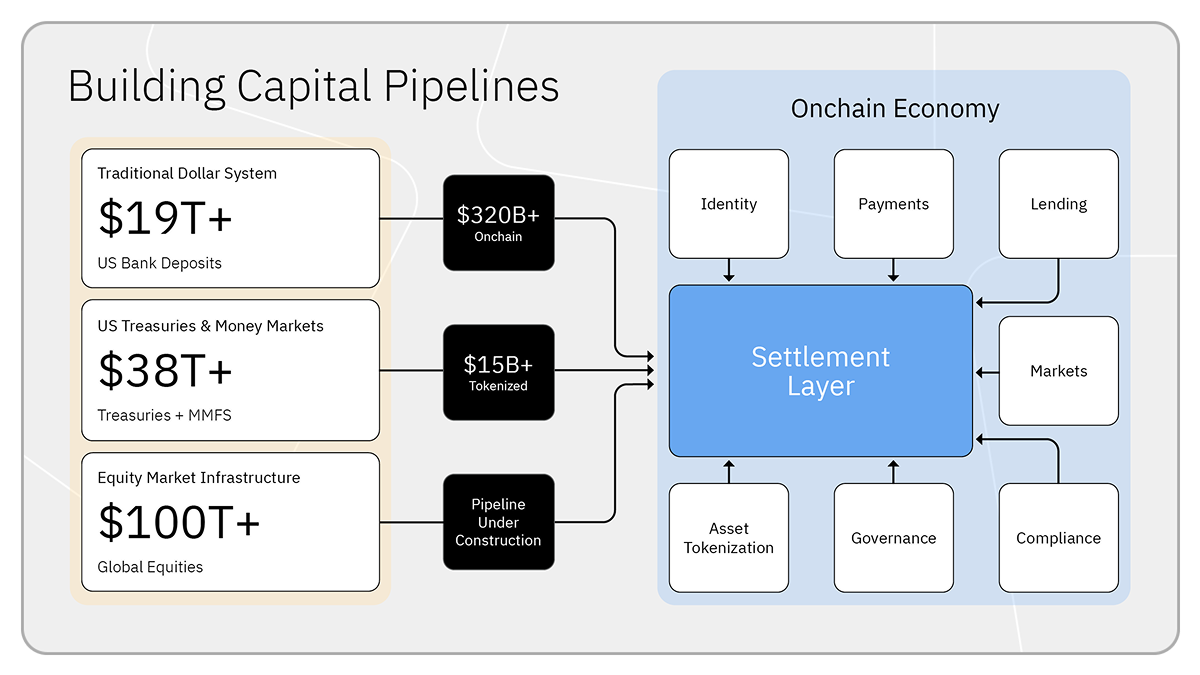
$19 trillion in US bank deposits. $38 trillion in treasuries and money market funds. $100 trillion in global equities. For the entire history of crypto, these pools of capital have been walled off from the onchain economy. Moving any meaningful amount required navigating a maze of intermediaries, regulatory ambiguity, and missing infrastructure. The pipelines didn't exist.
Over the last 12 to 18 months, that changed, quietly and on multiple fronts at once. What's been built is real infrastructure connecting the world’s biggest pools of capital to the onchain economy. And the scale of what can now flow through these pipelines is something I don't think most people have fully processed.
Dollars
Start with the most basic pipeline: the ability to move dollars onchain.
Stablecoin supply has crossed $320 billion, but that figure understates what just changed. For years, the pipeline for moving dollars onchain existed in theory but was effectively blocked. Banks and large institutions sat on the sidelines because there was no legal framework governing stablecoins, no clarity on reserve requirements, no defined regulatory perimeter. In that environment, a compliance officer at a major bank had every reason to say no and no reason to say yes.
The GENIUS Act changed that. For the first time, stablecoins have a federal legal framework: defined reserve standards, issuer licensing requirements, and clear regulatory jurisdiction. That matters less as a policy milestone and more as a practical one. It gives institutions the clarity they need to actually move, and the response has been immediate. The largest US banks, the major card networks, and the biggest payments companies are all now either live with stablecoin products or building them. JPMorgan, Citi, Bank of America, Visa, Stripe, PayPal. The list keeps growing. The pipeline from $19 trillion in US bank deposits into the onchain economy didn't just get built. It got unblocked.
And then there's the other direction. In March, Kraken's banking arm became the first digital asset company to receive a Federal Reserve master account. That's a direct connection to the core payments infrastructure of the United States. A crypto-native company now has the same access to the Fed's payment rails that traditional banks have. The significance is hard to overstate: it means a company whose primary business is facilitating growth of the onchain economy now sits inside the plumbing of the US financial system.
And so the pipelines are running in both directions: Traditional institutions are building pathways into the onchain economy and crypto-native companies are building pathways into the traditional financial system.
Treasuries and Money Market Funds
The next pipeline is short-duration government debt.
The US Treasury market is roughly $30 trillion. Money market funds hold another $8 trillion. These are the deepest, most liquid pools of low-risk capital in the world. And for the first time, direct pipelines now exist to move these assets onchain.
BlackRock's BUIDL fund has crossed $2.6 billion in tokenized treasuries deployed across multiple chains. Franklin Templeton has brought money market funds onchain. Janus Henderson's tokenized treasury product crossed $1 billion. And in total, the value of tokenized treasuries onchain now exceeds $15 billion. For years I endured headlines about ‘pilot projects’ that amounted to little, but today the world's largest asset managers are decisively moving core treasury and money market products onchain.
What this means: the lowest-risk, most liquid assets in traditional finance now have a direct path to the onchain economy. And once they're onchain, they become composable so they can serve as collateral in lending protocols, backing for stablecoins, inputs into yield strategies, and building blocks for products that don't exist in traditional finance. The pipeline moves the asset and then the onchain environment transforms what it can do.
Equities
This pipeline has been harder to build and it's one that’s just beginning to open.
The challenge with putting equities onchain has always been the layers of intermediaries involved: transfer agents, broker-dealers, clearinghouses, exchanges. Each one is a gate that has to open. Over the last few months, they've started opening in sequence.
Computershare, the transfer agent of record for roughly 58% of the S&P 500, partnered with Securitize to enable issuer-sponsored tokens, tokenized shares that are the actual equity, not a derivative or a wrapper, recorded on the same master securityholder file that has tracked DRS holdings for decades.
FINRA approved Securitize as the first full-stack onchain IPO underwriter, with the ability to custody tokenized securities and facilitate atomic settlement between securities and stablecoins inside a regulated broker-dealer.
The NYSE filed a rule change with the SEC to enable trading of securities in tokenized form, with 24/7 settlement and stablecoin funding, and tapped Citi as a settlement partner.
DTCC, the clearinghouse that processes the vast majority of US securities transactions, announced a tokenized securities platform launching in October with 50+ participating firms.
And Securitize, Jump Trading, and Jupiter launched fully onchain regulated trading for tokenized equities, combining institutional market-making liquidity, a DeFi distribution interface, and a regulated broker-dealer in a single stack.
What this means: every major layer of the equity market infrastructure, from the transfer agent to the broker-dealer to the exchange to the clearinghouse to the market maker, now has at least one participant building a direct pipeline to the onchain economy. This didn't exist a year ago. The pipeline from the $100+ trillion global equity market into the onchain economy is no longer theoretical.
Connect the Dots
The important point is that the core pools of traditional capital are all being connected to the onchain economy at the same time.
Dollars are moving through stablecoins. Treasuries and money market funds are being tokenized. Equity market infrastructure is beginning to support onchain issuance, trading, custody, and settlement.
Each pipeline is important by itself, but the more important point is that they reinforce each other. Stablecoins provide settlement. Tokenized treasuries provide collateral and yield. Tokenized equities expand the asset universe. Once all three exist together, the onchain economy becomes a new kind of financial substrate: one where dollars, collateral, and securities can move continuously, settle instantly, interoperate across applications, and be recombined into products that could not exist on legacy rails.
The onchain economy has spent most of its history building without direct access to the largest pools of capital in the world. Now it has pipelines to the heart of the financial system.
The content provided herein may include information regarding past and/or present portfolio companies or investments managed by Blockchain Capital or its affiliates and are provided for illustrative purposes only. The views expressed in each blog post are the personal views of each author and do not necessarily reflect the views of Blockchain Capital and its affiliates. Neither Blockchain Capital nor the author guarantees the accuracy, adequacy or completeness of information provided in each blog post. No representation or warranty, express or implied, is made or given by or on behalf of Blockchain Capital, the author or any other person as to the accuracy and completeness or fairness of the information contained in any blog post and no responsibility or liability is accepted for any such information. Nothing contained in each blog post constitutes investment, regulatory, legal, compliance or tax or other advice nor is it to be relied on in making an investment decision. Blog posts should not be viewed as current or past recommendations or solicitations of an offer to buy or sell any securities or to adopt any investment strategy. The blog posts may contain projections or other forward-looking statements, which are based on beliefs, assumptions and expectations that may change as a result of many possible events or factors. If a change occurs, actual results may vary materially from those expressed in the forward-looking statements. All forward-looking statements speak only as of the date such statements are made, and neither Blockchain Capital nor the author assumes any duty to update such statements except as required by law. To the extent that any documents, presentations or other materials produced, published or otherwise distributed by Blockchain Capital are referenced in any blog post, such materials should be read with careful attention to any disclaimers provided therein.



.png)
.png)
.png)

.png)
No Results Found.