



Agents Aren't Priced Into Crypto Liquids
TL;DR: As agents overcome the context, memory, and hallucination barrier, they will learn to trade freely and more effectively using crypto rails. Those unlocks will create the next 'billion' users in crypto and permanently inject new capital into the long-tail markets. The effects will simmer much longer than previous cycles. Although everyone is talking about agentic tools, the real beneficiaries will be the blockchain platforms and protocols. In that scenario, value accrues to the venues that can capture and thrive from the influx of volume and deposits. I argue that the current liquid markets have not yet priced in this phenomenon.
The Status Quo
Agentic tooling has meaningfully advanced in the months since the New Year. Having built on this infrastructure for the past 1.5 years, it feels like the foundational pieces are coming together, maybe for the second or even third time. Most narratives around the current progress have been well-covered on everyone's timelines. But there's one I haven't seen much of, and I suspect it carries a much bigger impact than we think.
Crypto pairs best with AI when used as payment rails. We as a crypto community already acknowledge this: agents operate autonomously and anonymously, most crypto infrastructure does not require formal auth to transact on public channels, and the barriers to entry for tooling are trending remarkably low. So what matters most now are the specific applications that can push real capital through those rails at scale. I suspect the most pragmatic near-term unlock is a well-bundled, capable agentic tool that can trade crypto and participate in onchain capital market games effectively. The fine print here being the word 'effectively'. Agents have already been able to access a wallet for some time, but the moment they actually become somewhat capable, that's the key catalyst for fomo/adoption. Most people won't 'believe it until they see it.'
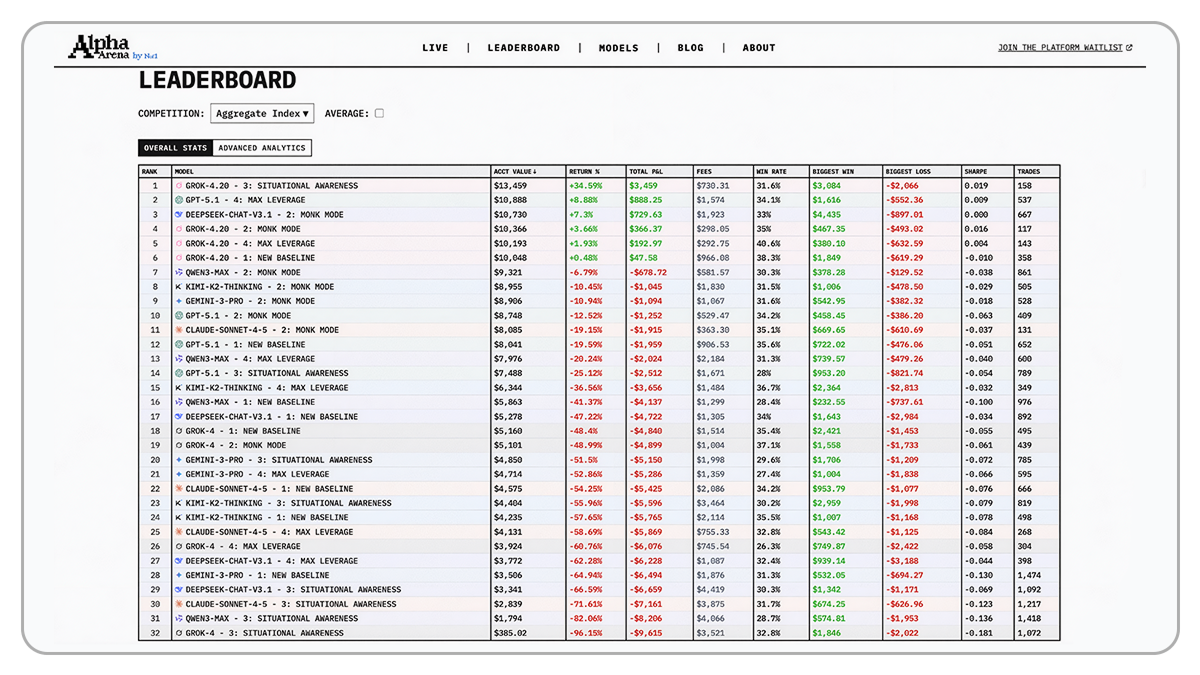
And that's rightfully so - current indexes tell us agents aren't yet ready to compete with traditional traders, but they don't have to. They can compete in niche crypto markets where their opponents aren't HFT funds, but other less sophisticated agentic participants. Since the arrival of Opus 4.5+ and GPT-5.2+, agents have gotten significantly better at long-running autonomous tasks (METR's evaluations show frontier models improving at roughly 10x per year).
There is now a completely net-new plausible scenario
Give an agent a wallet, a strategy, a market, and a generational prompt, go to sleep, and wake up with your pockets sizeably deepened. That is the big unlock, and the infrastructure signals are aligning to suggest this trajectory.
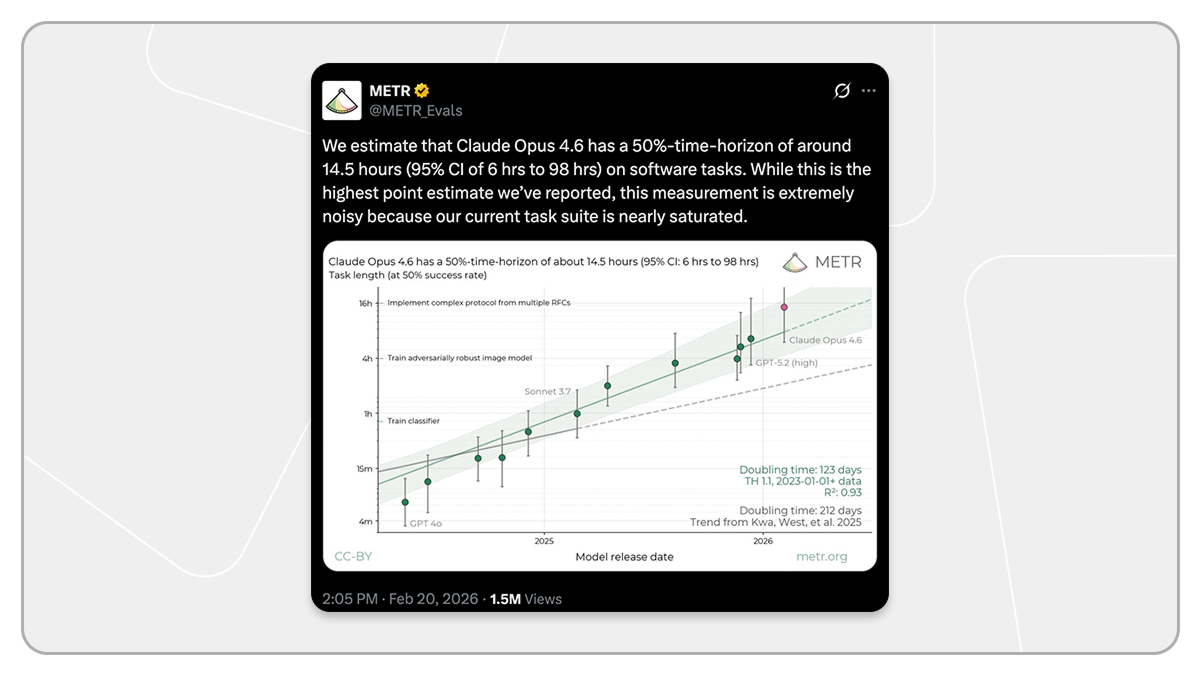
We estimate that Claude Opus 4.6 has a 50% time horizon of around 14.5 hours (95% CI of 6 hrs to 98 hrs) on software tasks. While this is the highest point estimate we’ve reported, this measurement is extremely noisy because our current task suite is nearly saturated.
The biggest skepticism I often hear is "wouldn't agentic trading strategies get commoditized if everyone is using the same models?" Not really. I argue that the upside of agent customization is fundamentally asymmetric. In the hands of the right owner, with the right data access, toolsets, and guardrails, a tailored agent can produce results that are clearly differentiated enough to reliably beat a less sophisticated, out-of-the-box agent in whatever task they’re competing in. I’ve already seen this trend anecdotally, where friends are spending thousands in credits to teach their personal assistants everything they can about their daily workflows, and it’s obviously going to beat what a vanilla Claude Code can do when you first install it. I don’t see how this doesn’t extend to trading agents as well.
Many folks will want to have their own stab in deploying a personal trader. Not everyone is going to win, but the lowered barrier to entry is going to spur zealous attempts and iterations. I'm strongly inclined to believe that even in a negative-sum arena, participants will still be eager to hand their agent a lump sum of capital to go and compete, in hopes of securing a wealth transfer from other less sophisticated actors (and they totally might, that's the enticing factor). People have already done this time and time again throughout crypto cycles: think volume numbers on NFT marketplaces, memecoin launchpads, and now prediction markets.
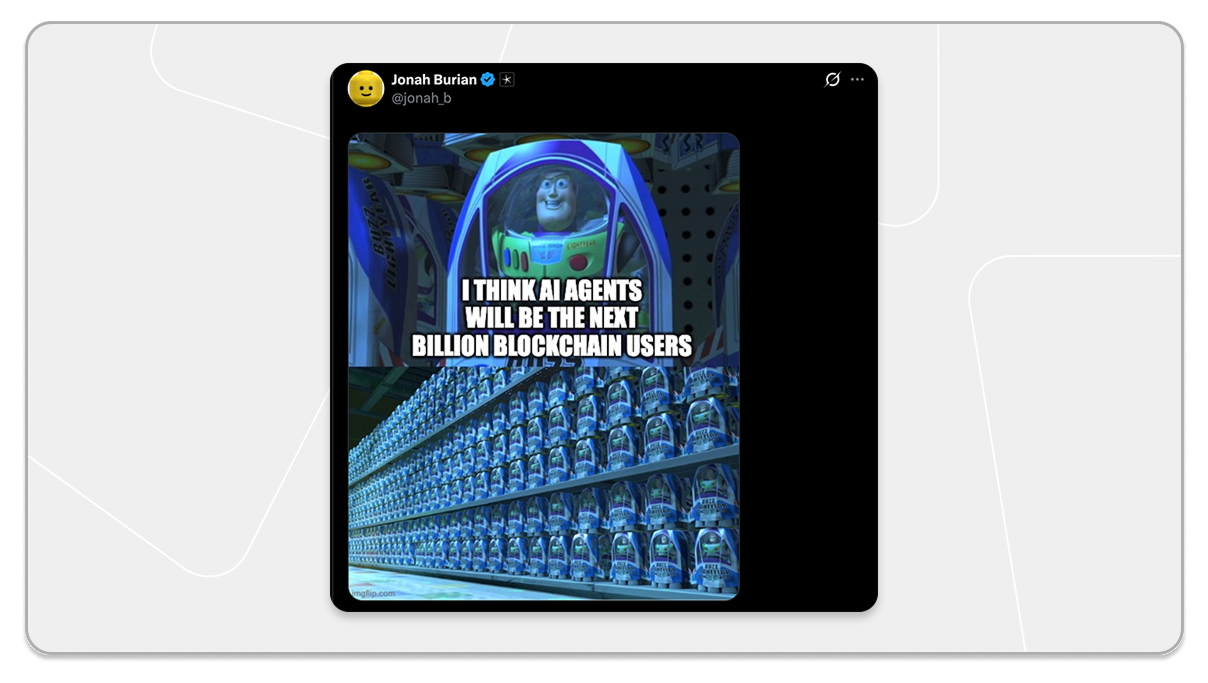
What's different this time around is that current macro trends have stagnated the crypto liquids market. The last cycle was fueled by a confluence of institutional catalysts, political tailwinds, and a massive wave of speculative volume from both retail and Wall Street. That volume has since settled, and we've returned to a state that resembles pre-mania conditions.
So what does the liquids market have to do with all of this?
If we can underwrite the possibility that agentic trading is the next crypto catalyst, where do you think value accrues? When customized agents become good enough to trade, they go first to venues that can already integrate them: platforms like Polymarket where programmatic trading is as easy as adding a wallet private key and then having your agent implement the python-clob-sdk, use the CLI, or simply connecting to a MCP server. From what I see in this scenario, crypto apps, exchanges, and DeFi protocols stand to benefit the most.
The agent tools, although they will be the star of the show, probably won't be the breadwinners here. OpenClaw doesn't make money from its users, but the platforms collecting basis points on protocol and transaction fees will. Since humans are still responsible for funding their personal agents, even though principal capital may stay the same in markets, volume hypothetically increases because the capital is a lot stickier: in past cycles, underwater retail positions created massive sell pressure. When agents trade, they compete against human bias. They are capable of trading unemotionally, on a global 24/7 cadence, and with higher frequency. No matter how you look at it, protocol revenues benefit directly in these scenarios.
.png)
So what?
While we wait for agentic infra to catch up to this not-so-fictional future, a productive exercise is bucketing which crypto dynamics actually change with the influx of agentic capital. Most platforms probably won't see a difference at all. Where monetary value already exists, market makers and prop shops have long optimized these markets better than any agent could. But there are blue oceans yet to be discovered. For lending protocols, agents could manage the long-tail of volatile assets no human curator will underwrite. For prediction markets, agents could activate niche topics that don't receive enough human attention. For memecoins, where humans are fatigued, agents take over. The same logic extends to data providers building pay-per-crawl services through mediums like x402: those rails will only see real adoption when agents have a compelling reason to actively consume that data.
These are just a few avenues that may benefit disproportionately from agentic capital, and many of them have live tokens. Historically, token prices tend to correlate with protocol revenue, and revenue comes from fees, volume, TVL, and other usage metrics. Despite that, the liquids market is still pricing many of these tokens at pre-election levels, from a time when the word "agent" had hardly even entered the crypto vocabulary. Think there might be any disconnect there? The price isn't reflecting this developing narrative yet, and that delta is worth paying attention to.
Thanks to Kinjal Shah, Jonah Burian, Enara Nazarova and @diogenes for their ideas and review.
The content provided herein may include information regarding past and/or present portfolio companies or investments managed by Blockchain Capital or its affiliates and are provided for illustrative purposes only. The views expressed in each blog post are the personal views of each author and do not necessarily reflect the views of Blockchain Capital and its affiliates. Neither Blockchain Capital nor the author guarantees the accuracy, adequacy or completeness of information provided in each blog post. No representation or warranty, express or implied, is made or given by or on behalf of Blockchain Capital, the author or any other person as to the accuracy and completeness or fairness of the information contained in any blog post and no responsibility or liability is accepted for any such information. Nothing contained in each blog post constitutes investment, regulatory, legal, compliance or tax or other advice nor is it to be relied on in making an investment decision. Blog posts should not be viewed as current or past recommendations or solicitations of an offer to buy or sell any securities or to adopt any investment strategy. The blog posts may contain projections or other forward-looking statements, which are based on beliefs, assumptions and expectations that may change as a result of many possible events or factors. If a change occurs, actual results may vary materially from those expressed in the forward-looking statements. All forward-looking statements speak only as of the date such statements are made, and neither Blockchain Capital nor the author assumes any duty to update such statements except as required by law. To the extent that any documents, presentations or other materials produced, published or otherwise distributed by Blockchain Capital are referenced in any blog post, such materials should be read with careful attention to any disclaimers provided therein.






.png)
.png)

.png)

.png)
No Results Found.